



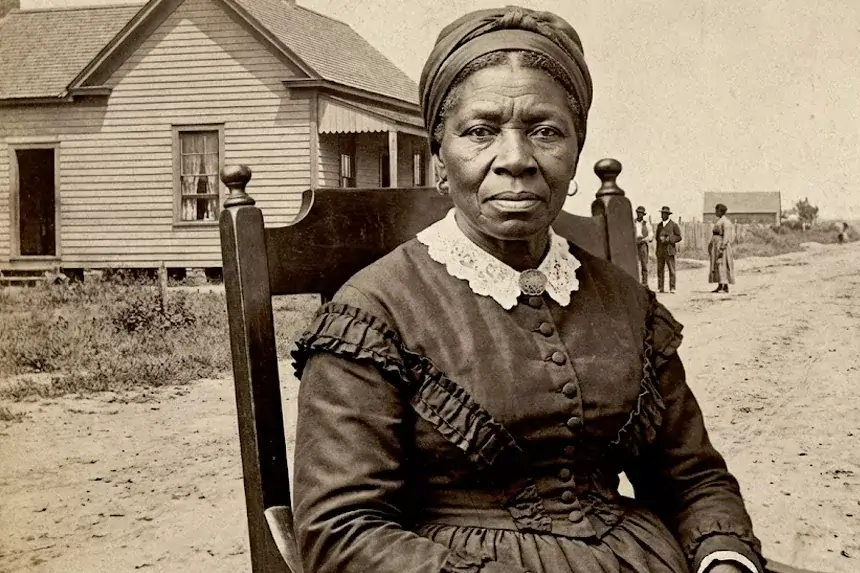
Biddy Mason died in 1891 with an estate worth $300,000, making her one of the wealthiest women in California during the late 1800s. Her fortune came from real estate investments in downtown Los Angeles. She bought her first property in 1866 for $250 and spent the next 25 years building a property portfolio that established her financial standing among LA’s elite. The story of her accumulated wealth demonstrates how she transformed from destitution into prosperity through careful saving and smart land purchases.
- Biddy Mason’s Fortune at Death
- From Nurse to Property Owner
- Her First Real Estate Purchase in 1866
- Building Her Property Portfolio
- What Her Estate Would Be Worth Today
- The Real Estate Value Question
- What Happened to Her Wealth and Properties
- Missing Records and Uncertainties
- Why Her Financial Story Matters Today
Biddy Mason’s Fortune at Death
When Mason died in 1891, her net worth was approximately $300,000. This estate value placed her among the richest people in Los Angeles at the time.
Mason earned $2 per hour working as a nurse for a Los Angeles doctor. She saved every penny for over a decade before buying her first piece of land. By 1884, she was selling properties for thousands of dollars. Her wealth accumulation came from smart timing. She bought cheap land on the edge of town and watched it turn into prime commercial space as Los Angeles grew. The monetary value of her purchases multiplied as the city expanded around her holdings.
The money she earned as a midwife and nurse gave her the seed capital to enter real estate. She reinvested profits from each sale into new properties. This approach turned a single lot worth $250 into an estate worth hundreds of times more by the time she died. Understanding the true worth of her name requires examining both its financial assets and the meaning of worth itself—from the Old English “wurth,” signifying both price and merit, Mason’s Biddy Mason Net Worth reflects dual meanings: her economic prosperity and her intrinsic value to Los Angeles.
From Nurse to Property Owner
Mason gained her freedom in 1856 after a California court ruled in her favor. She worked as a nurse and midwife, delivering hundreds of babies during her career.
After saving for 10 years, she followed the examples of her employers, both real estate investors, and bought a piece of land on the outskirts of town. The location seemed risky at first. At that time, this area was considered “out of town”. But Mason understood something important. Los Angeles was growing fast, and land near the center would become valuable.



She worked long hours delivering babies and treating patients. She became one of the most in-demand midwives in Los Angeles, catering to the needs of both wealthy residents and impoverished new arrivals. Every dollar she earned went into savings. She lived simply and planned carefully. Ten years of work gave her enough money to make her first purchase, beginning her journey from poverty to affluence.
Her First Real Estate Purchase in 1866
In 1866, Biddy Mason made her first land purchase at 48 years old. She paid $250 for a lot between 3rd and 4th on Spring Street. This location sits in what we now call downtown Los Angeles.
She purchased a nearly one-acre site between present-day Broadway and Spring Street, between 3rd and 4th Streets. Spring Street connected to Main Street. It was becoming an important path through town. Some accounts indicate that land investment was a major focus of her life. More reliable accounts show that it was likely that she was securing her family’s future by owning land on which they could live.
She built her home at 331 Spring Street. The house served multiple purposes beyond just shelter. It became a gathering place for the community. But more importantly, it represented her first major asset. She now owned something that could grow in value as the city expanded around it. This land holdings value would form the foundation of her real estate fortune.
Building Her Property Portfolio
Mason did not stop at one property. Two years later, she purchased more land. She bought and sold strategically over the next two decades.
In 1875, Mason sold the north half of the Spring Street property to K.H. Jones and Charles M. Wright for $1,500. That single sale gave her six times what she paid for the entire original lot. She sold a property that she purchased on Olive Street for $375 in 1868 for $2,800 in 1884. This showed a return of more than seven times her original investment, demonstrating exceptional property appreciation rates.
She understood market timing. In the 1880s, as the population in Los Angeles was increasing and Spring Street was becoming a bustling place for shops and boarding houses, she sold at the right moments. The city was growing around her properties. Each year brought new businesses and residents. The land assets she bought cheap became expensive as downtown developed. Mason mostly purchased commercial real estate, focusing on properties that would generate income or appreciate rapidly.
What Her Estate Would Be Worth Today
Converting 19th-century assets to modern values requires careful calculation. $300,000 in 1890 is now equivalent to $10,680,527.47 in 2025, based on inflation data from the Bureau of Labor Statistics.
This figure only accounts for basic inflation through a standard estate appraisal method. It does not consider real estate appreciation beyond general price increases. Forbes Magazine reported in 2019 that the land she owned in downtown Los Angeles is now worth hundreds of millions. The difference between $10.68 million and hundreds of millions shows how valuable downtown LA real estate has become. This property valuation gap reveals the extraordinary inter-generational wealth transfer potential that existed in her holdings.
Different sources give varying estimates of her total estate. Some state her estate was equivalent to $9 million in earlier calculations. Others cite about $7.5 million in today’s dollars. One source estimated her wealth at about $3 million. These variations depend on which year the conversion was calculated and which inflation measure was used. The 2025 calculation of $10.68 million represents the most current inflation adjustment available for understanding her overall wealth position.
The Real Estate Value Question
The original property locations matter for understanding true modern value. Her homestead was located between present-day Broadway and Spring Street, between 3rd and 4th Streets. This is now the heart of downtown Los Angeles.
A UCLA professor stated that the lots she owned in downtown Los Angeles today would be worth about 8 million dollars. But this estimate appears conservative. During the early 20th century, the area of Ms. Mason’s real estate holdings was referred to as the Wall Street of the West. It is now known as Gallery Row.
Downtown LA commercial real estate commands premium prices in 2025. A single lot between 3rd and 4th Streets on Spring or Broadway could sell for millions. Mason owned multiple lots in this area. If her family had retained all the original property wealth, the portfolio would likely be worth far more than the inflation-adjusted estate valuation of her 1891 personal wealth.
The exact current value remains difficult to pin down. Her descendants note that the land is now worth hundreds of millions, but no recent formal appraisal exists for the specific lots she once owned. The property values have increased at rates far exceeding general inflation, making her original investments extraordinarily prescient.
What Happened to Her Wealth and Properties
Mason had a will and left an inheritance for her two surviving daughters. Understanding what happened to her financial success after death reveals both triumphs and challenges of wealth transfer for Black families in early America.
In 1884, she had the Spring Street parcel deeded to her grandsons, Robert and Henry. Her daughter, Ellen, Robert’s wife, also was given land to live on until she died. Her grandson, Robert Curry Owens, was a prominent Southern Californian businessman, said to be the most influential black man in California. He remained a well-known and respected figure all his life, dying in 1932. This showed successful inter-generational wealth transfer to at least the second generation.
The primary real estate she owned was donated to be used by the first AME (African Methodist Episcopal) Church in Los Angeles. Mason’s land purchase marked the beginning of the development of what’s known today as downtown Los Angeles. This was before systemically racist laws and policies were developed that kept Black people from achieving generational wealth. Her timing proved crucial—she built wealth before many discriminatory barriers were erected.
Biddy Mason has four living descendants: her 4th great granddaughters Cheryl and Robynn Cox, and her fifth great-grandchildren Daniel and Dakota. Cheryl Cox Co-Founded The Biddy Mason Foundation in 2012 with her mother and sister, expanding on the decades of philanthropy her mother had established. The family continues her tradition of service, though they no longer hold the original properties.
Missing Records and Uncertainties
Many details about Mason’s finances remain unclear. Records from the 1860s through 1890s are incomplete. We know she owned multiple properties, but exact boundaries and total acreage are not fully documented.
The $300,000 estate figure may not include all properties she once controlled, since she deeded some properties to family members before her death. We also do not know if she carried debts. The $300,000 figure represents her estate value, but whether this was net worth after liabilities is unclear. Most sources treat it as her total wealth, but 19th-century record keeping was not as detailed as modern financial accounting.
Another unknown involves properties she may have bought and sold without recorded deeds. She continued to buy and develop more lots in Los Angeles, but we lack a complete list of every transaction. The documented sales show her profit pattern, but there may have been additional deals not captured in surviving records.
Why Her Financial Story Matters Today
Mason’s wealth accumulation shows what was possible through real estate investments during Los Angeles’ early growth period. She entered the market at the perfect time. The city was expanding, and she bought before prices rose.
Her story also highlights the challenges of documenting 19th-century wealth, especially for women and people of color. A descendant noted that her name appeared in textbooks only as a small mention on the page spine, as if she was an afterthought. This lack of recognition extended to financial records. Many of her achievements were not preserved in detail.
The gap between her inflation-adjusted wealth ($10.68 million) and the current value of her former properties (potentially hundreds of millions) demonstrates how property holdings appreciate beyond simple inflation. Downtown real estate in major cities grows in value faster than the general price level. Mason’s financial decisions in the 1860s and 1870s would have created generational wealth if her descendants had been able to maintain ownership.
Understanding her Biddy Mason Net Worth requires looking at multiple factors. The $300,000 estate value represents her 1891 position. The $10.68 million figure shows inflation adjustment. The “hundreds of millions” estimate reflects what her land would be worth if still owned as a single portfolio. Each number tells a different part of her financial story and demonstrates both her economic prosperity during life and the affluence her investments could have generated for future generations.
The family hopes that the city will name a portion of Spring Street after her, a fitting tribute to the woman whose riches helped build downtown Los Angeles and whose financial standing remains unmatched among early Black women entrepreneurs in California.
Key Points About Biddy Mason’s Net Worth:
- Her 1891 estate was valued at $300,000, making her one of the wealthiest women in California at the time, with her accumulated fortune placing her among LA’s elite.
- Adjusted for inflation, her wealth equals approximately $10.68 million in 2025 dollars, though this only accounts for general price increases, not the exceptional property appreciation rate of downtown LA real estate.
- Her downtown Los Angeles properties would be worth hundreds of millions today if they remained intact, showing how land holdings value can exceed basic inflation calculations over generations.
- She started with a $250 property purchase in 1866 and grew her property wealth through strategic buying and selling over 25 years, demonstrating exceptional financial success despite never learning to read or write.
- She left an inheritance for her daughters and grandsons, with some properties deeded before her death and her primary estate valued at $300,000, though the inter-generational wealth transfer faced challenges common to Black families in that era, with most original holdings eventually sold or donated rather than retained by descendants.